
The website contains cookies
By continuing to read, you accept that our website uses cookies to enhance your user experience.
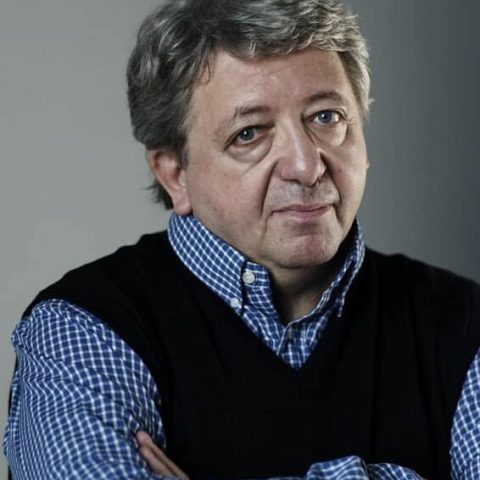
Literature was present in his life from a very young age, a sign that it would later become his true vocation. As a high school student, he took part in the National Studies Competition, and wrote his entry from the plays of Imre Sarkadi.
In 1964 he went to primary school in Irányi Street, Pest. In 1967, he graduated from the Eötvös József Gymnasium (Reáltanoda Street). Although he won the academic competition, he was not admitted to the university due to cultural policy decisions. He was obliged to learn a foreign language. He did so, passing the Russian state secondary language exam in 1968. But then he had to do a year of conscript service as a pre-entry student before entering university. He was able to get out of this by attending art college, so he wanted to be an actor and applied to the Academy of Dramatic Arts. But then, by a strange twist of fate, another order was issued and he was to enlist as a soldier here too. Finally, he was granted a one-year deferment and was able to start school, where he studied theatre directing instead of acting, in 1969-73. Between 1972 and 1973 he directed at the Csiky Gergely Theatre in Kaposvár.
His first directorial work at the age of three, in 1971 in Kaposvár (he replaced the ailing István Komor) was Jean Giraudoux’s play Troy There Will Be No War. The second play he directed was Yevgeny Svarc’s The Snow Queen. Hungarian audiences were introduced to the play in József Romhányi’s comic-cinematic adaptation for children, but he adapted it from the original manuscript. Andor Lukáts, Róbert Koltai, László Vajda and István Verebes were in the cast of the premiere of The Snow Queen. The sets and costumes were designed by Gyula Pauer[2]. His third production, which was also his examination, was Molière’s Tartuffe in 1973. Tartuffe was played by István Verebes, Dorine the maid by Piroska Molnár, Orgon by Vilmos Kun, Elvira by Éva Olsavszky. After graduating, however, he gave up directing after the political control of his theatre directing activities was imposed.
It has terminated contracts with the theatres in Szolnok and Kaposvár. He decided to write, and the poet György Petri became his master. He wanted to live as free and politically independent as he did. Through Petri he came into contact with the democratic opposition. He went his own way, giving readings of his works in private homes between 1973 and 1976. Most often, János Kenedi made his apartment available for uncensored and therefore dangerous readings. This was one of the first manifestations of the democratic opposition’s activities. Between 1974 and 1978, he worked for the Hungarian Radio’s Youth Department as a member of the staff, producing children’s programmes and fairy-tale plays for a living.
In 1978, he founded his first samizdat newspaper, A Napló, a closed but free chain, which bypassed censorship. Later that year, he was dismissed from the Radio, along with 17 other Hungarian intellectuals, on the false charge that his anti-Soviet writings, edited by János Kenedi, had been published by Random House under the title Profil. Kornis put all this in literary form in his 2003 memoir Civilians on the Track, Before the Pestis.
Then, with the help and intercession of Özséb Horányi and Géza Bereményi, he got a job as an assistant at the Pannónia Film Studio between 1978-1981. Then the Vígszínház came to his rescue, Zsuzsa Radnóti got him a playwriting scholarship and, on István Paál’s recommendation, he was hired as a dramaturg at the Szigligeti Theatre in Szolnok, 1981-1983.Between 1984-1989, with the help of Károly Makk, he got an assistant directing job at Mafilm, but in fact he and Makk worked for years on a film script based on his play Kozma – in vain. Three versions of the screenplay were rejected by the Film Board. Kozma was premiered in 1986 in Kaposvár, directed by János Ács – Piroska Molnár in the lead role was awarded the Critics’ Choice Award for Best Actress of the Season, Judit Pogány received the Best Performance in an Episode – and in 1987 at the Pesti Theatre, directed by István Horvai, with Mari Törőcsik, Vera Pap and Enikő Eszenyi in the lead roles. (That year, Törőcsik was awarded the prize for best female performance.)
Between 1990 and 2002, he was a lecturer in theatre and film analysis at the University of Theatre and Film Arts, giving lectures to future actors, theatre and film directors.Between 1990 and 1996, he was dramaturg at the Katona József Theatre, between 1996 and 2003 artistic advisor at the Víg Theatre, from 2003 chief artistic advisor at the Madách Theatre, and from 1994 member of the board of trustees of the journal Magyar Lettre Internationale.
By continuing to read, you accept that our website uses cookies to enhance your user experience.